Healthcare Workers Navigating the Endemic Crisis
Article by Jana Šimenc, PhD, Slovenija-transplant
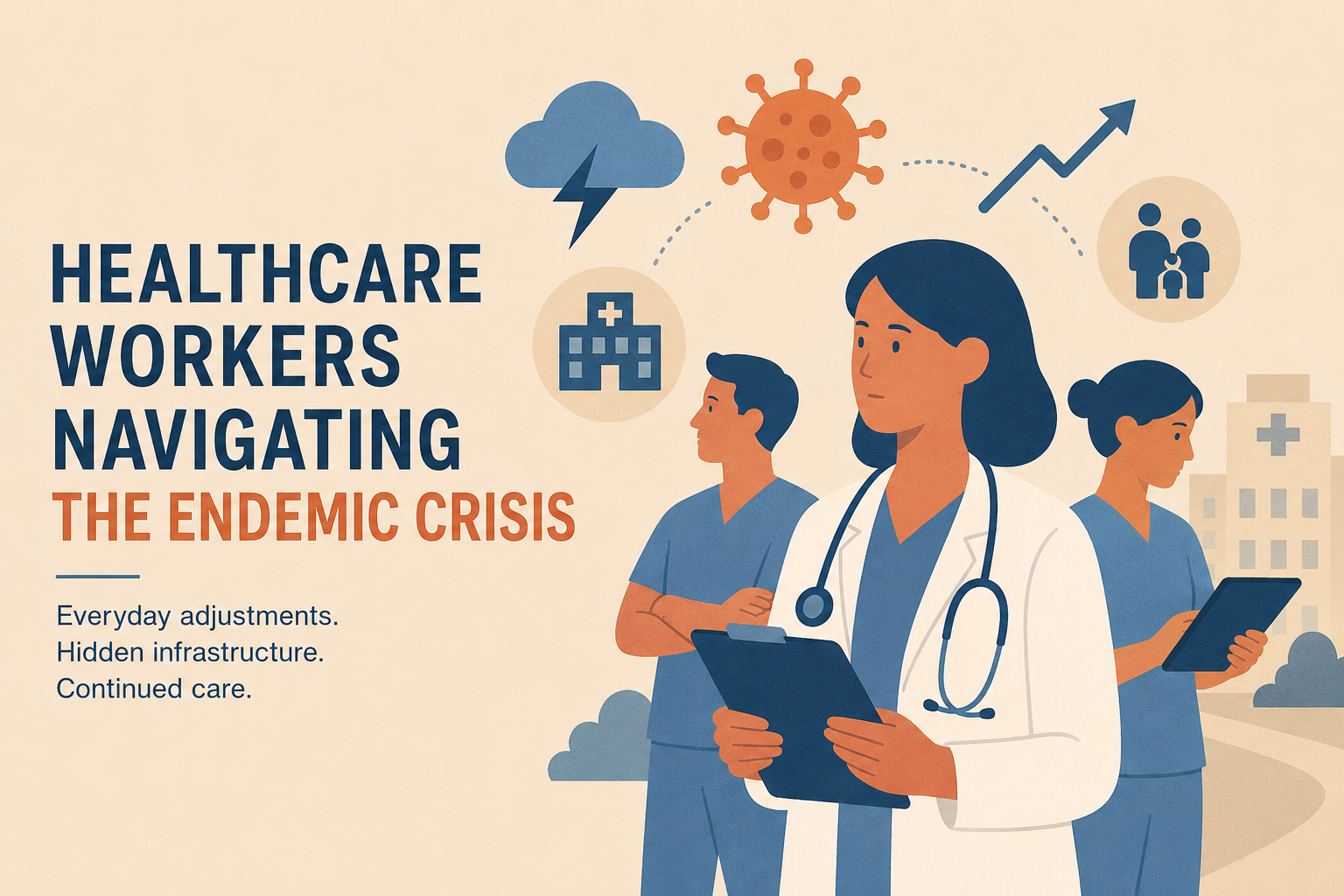
The healthcare crisis has shifted from an exceptional event to an enduring condition, while healthcare workers' everyday adjustments help sustain systems under pressure. In the short piece, I offer a broader anthropological insight into the understanding of enduring crisis in health care and in the often overlooked hidden infrastructure health care workers develop in everyday hospital practice.
Crisis has traditionally been understood as a moment of rupture: an exceptional event that interrupts ordinary life and demands an extraordinary response before a return to normality becomes possible. Yet in the contemporary world, this distinction between crisis and normality is increasingly difficult to sustain (1,2,3). The COVID-19 pandemic, geopolitical instability, economic uncertainty, environmental disasters, technological disruption and growing social polarisation have created conditions in which one crisis overlaps with another and uncertainty itself becomes enduring.
In an influential article “Crisis and Chronicity”, anthropologist Vigh argues that crisis can be endemic rather than episodic. Instead of treating crisis as a rupture from normality, he proposes understanding “crisis as context”: the social terrain within which people act, plan, and navigate their lives (3). What was initially considered an exceptional event gradually becomes a routine. In anthropology, we talk about the normalisation of crisis.
Rather than asking when society and healthcare systems will return to normal after a crisis, we may therefore need to ask a different question: what happens when crisis itself becomes part of normality?
Healthcare provides a particularly revealing setting in which to examine this transformation. As Tmava and Burstein argue, COVID-19 persists as a structuring condition that continues to affect individual experiences as well as domestic and global politics and culture (4). The legacy of the pandemic has permeated every level of today’s social, economic and health spheres. The pandemic has opened a specific Pandora’s box in health care, where systems in particular remain under enduring pressure.
The acute emergency of COVID-19 may have passed, but healthcare systems continue to operate under persistent pressures, including workforce shortages, financial constraints, long waiting times, organisational instability and increasing demands for care. Conditions initially experienced and managed as exceptional have, in many cases, become incorporated into everyday healthcare practice. Healthcare workers do not simply respond to these circumstances; they continually navigate, adjust, improvise and develop formal and informal ways of maintaining care despite instability.
Drawing on the work of Merleau-Ponty, anthropologist Anna Harris developed the concept of “adjustment” as a movement between habit and the moment (5). Health care workers learned to operate within conditions of prolonged uncertainty. They have been improvising, adjusting to altered working conditions, so that hospitals continue functioning, patients are still being treated, and the institutions haven't collapsed. Their continuous adaptations create an often-overlooked hidden infrastructure of care: practical knowledge, informal relationships, improvisations and everyday adjustments that enable healthcare institutions to continue functioning despite structural pressures.
The complex situation challenges the traditional model of crisis. Rather than the assumption that crisis is a temporary rupture between periods of normality, we can think about a more flexible model of the enduring crisis. With innovative navigation in crisis, health care workers are developing a hidden “infrastructure” that should not be overlooked when dealing with crisis in health care.
Conceptual framework: Chronic crisis → uncertainty → navigation → adjustment/improvisation → routinization → hidden infrastructure → continued functioning of everyday hospital health care.
This raises a critical question: when healthcare systems depend upon the continuous adaptation of their workers to crisis conditions, where does crisis end and normal healthcare practice begin?
Today, crisis has become lived and negotiated in everyday health care practise. Healthcare workers and patients learn to live and work within them. Still, an important critical paradox should not be overlooked: healthcare workers' ability to keep the system functioning may simultaneously make the depth of the structural crisis less visible.
Sources:
Janet Roitman: Anti-Crisis. Durham: Duke University Press, 2013.
Henrik E. Vigh: Navigating Terrains of War: youth and soldiering in Guinea-Bissau, Oxford/New York: Berghahn, 2006.
Vigh, H. (2008). Crisis and Chronicity: Anthropological Perspectives on Continuous Conflict and Decline. Ethnos, 73(1), 5–24. https://doi.org/10.1080/00141840801927509.
Tmava, A., & Burstein, E. M. (2025). A call for a critical medical anthropology of the COVID-19 pandemic. Anthropology & Medicine, 32(2–4), 75–81. https://doi.org/10.1080/13648470.2025.2604010.
Harris, Anna (2014) Encountering the familiar unknown: The hidden work of adjusting medical practice between local settings. Journal of Contemporary Ethnography 43 (3): 259 – 282. http://jce.sagepub.com/content/early/2013/07/11/0891241613494810.full.pdf+html.