Living with Uncertainty, Building Resilience: The Strategic Role of Patients in Strengthening Transplant Systems
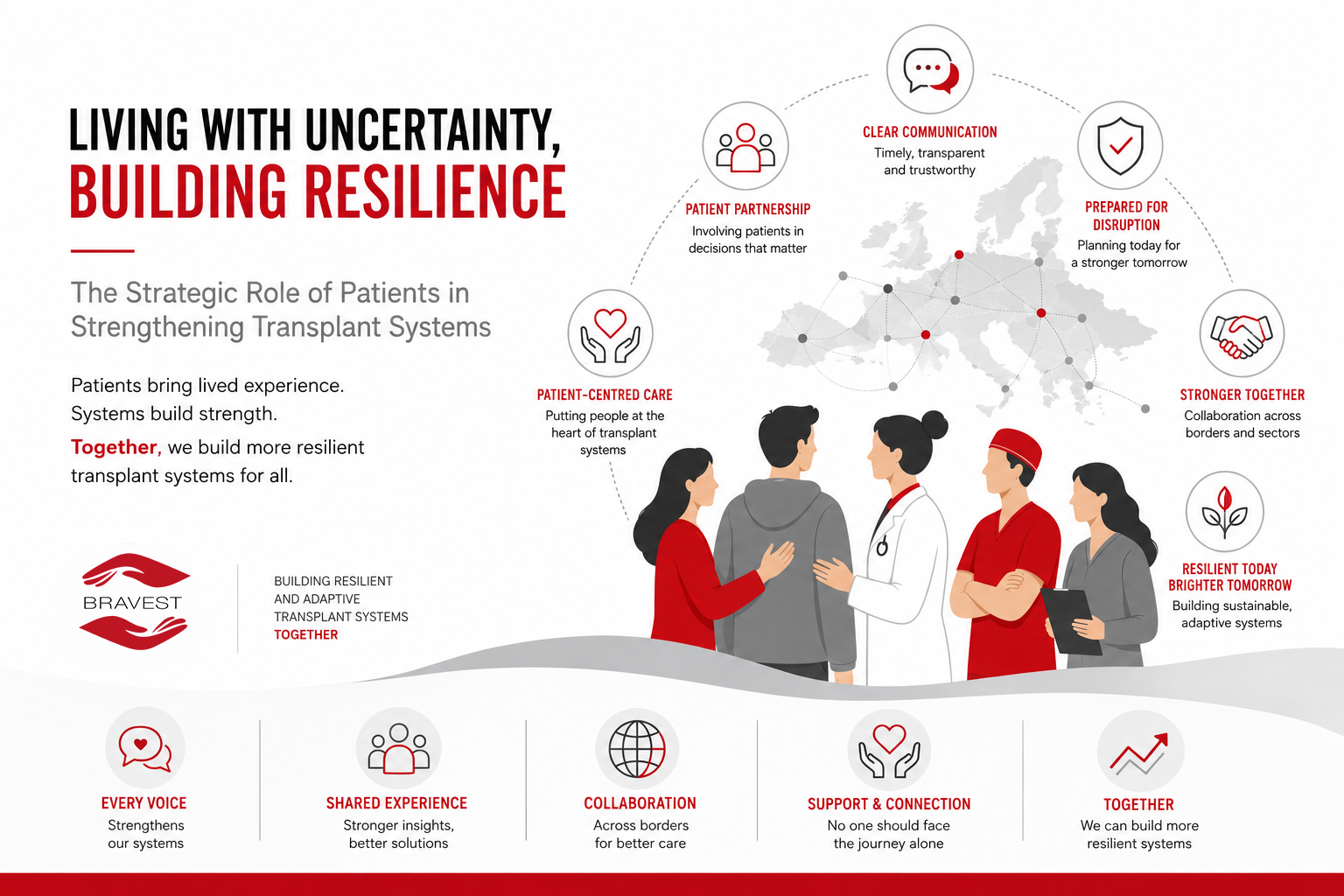
Article by Colin White, ESOT Patient Inclusion Strategy Manager
Life on the organ transplant waiting list is defined by uncertainty. The questions come quickly, and clear answers rarely follow. Some are existential - will I receive the call in time? Will the operation be a success? How long will recovery take, and how will I adapt to my ‘new’ life? How long will the transplant last? Others are more immediate and practical - who will feed the cat if ‘the call’ comes in the middle of the night? Will I be able to pursue my favourite hobbies post-transplant?
Yet for all the weight of these questions, most patients find ways to carry them. They build routines, lean on the people around them, reach out to patient organisations and develop - often without naming it as such - a form of personal resilience that sustains them through the wait, the operation, and the process of recovery that follows. What is less often asked is whether the organisations and systems responsible for organ donation and transplantation have built that same capacity for resilience into themselves.
For patients active on the transplant list during the SARS-CoV2 pandemic, there was a whole new level of uncertainty. Transplant programmes were halted, or their capacity to function was significantly diminished. Given that a transplant patient’s immunity is most compromised in the immediate post‑operative period, the anxiety levels related to going through a transplant whilst the pandemic was in full flow were significant.
The patient perspective on building resilience
Resilient healthcare systems are not built solely through infrastructure, workforce capacity or emergency preparedness. They also depend on understanding how operational decisions affect the people who rely on the services provided. Patients bring unique insights into continuity of care, communication, access, safety and the unintended consequences of service redesign. Integrating these insights into operational planning strengthens both resilience and patient-centred care.
Patients experience healthcare as a continuous journey rather than as a series of organisational processes. As a result, they often identify operational risks and unintended consequences that may not be immediately apparent to healthcare professionals or managers. Their lived experience complements clinical expertise and operational management, providing valuable insights that support more informed and patient-centred decision-making. True operational resilience therefore extends beyond focusing on the maintenance of hospital capacity - it must also ensure the continuity, quality and accessibility of patient care throughout periods of disruption.
Communication in a time of crisis - Patient organisations as partners
Clear, timely and trustworthy communication is essential during periods of uncertainty. Whether responding to travel disruption or awaiting a life-saving organ transplant, people rely on accurate information to make informed decisions, manage expectations and reduce anxiety. In healthcare, where uncertainty can have profound clinical and emotional consequences, effective communication is not simply supportive - it is a critical component of high-quality, resilient care.
While healthcare providers are responsible for clinical guidance and operational decisions, patient organisations have distinctive strengths that make them essential partners in a crisis.
One of the greatest strengths of patient organisations is their established communication networks. Through mailing lists, websites, social media channels, peer support groups, webinars and community events, they maintain regular, direct contact with patients and their families.
These networks enable information to be disseminated rapidly and consistently during periods of crisis, extending the reach of healthcare providers beyond traditional clinical settings. Because these channels are underpinned by trusted relationships and shared lived experience, patient organisations are uniquely positioned to reinforce official guidance, address misconceptions, encourage appropriate health behaviours and provide reassurance at times of uncertainty.
Their communication networks also create valuable feedback loops, enabling emerging concerns, patient experiences and practical challenges to be relayed quickly to healthcare providers, supporting more responsive and patient-centred decision-making.
By embedding patient organisations within emergency preparedness and operational planning, healthcare systems can improve public trust, reduce misinformation, support informed decision-making and build more resilient, patient-centred services. In transplantation, where patients often face complex clinical decisions and heightened vulnerability during crises, these partnerships are particularly valuable, ensuring that communication is both clinically accurate and grounded in the lived experience of those most affected.
Embracing an opportunity
Through the BRAVEST project and ESOT's Patient Inclusion Initiative, ESOT is uniquely positioned to lead the development of a European framework that embeds patient organisations as strategic partners in emergency preparedness and operational planning across transplantation.
The Patient Inclusion Initiative has the potential to provide the governance structure through which patient representatives can contribute to preparedness planning at both European and national levels.
Supporting Research and Policy Development
Looking to the future and the opportunity to generate new evidence on the contribution of patient organisations to healthcare resilience.
Potential areas of research include:
the effectiveness of patient involvement in emergency planning;
communication strategies during healthcare crises;
continuity of transplant care during system disruption;
patient-reported outcomes and experiences during emergencies;
organisational factors that support resilient patient partnerships.
The findings can inform future ESOT policy, European guidance and national preparedness strategies.
A Sustainable Governance Model
The success of this approach depends upon embedding patient partnership within governance rather than relying on informal consultation.
The BRAVEST project highlights an opportunity for ESOT to demonstrate international leadership in patient-centred resilience. By combining the scientific expertise of the transplant community with the lived experience and communication strengths of patient organisations, ESOT can help shape a new model of emergency preparedness in which patients are recognised not only as beneficiaries of healthcare services but as active partners in protecting their continuity, quality and resilience.
Embedding patient organisations within emergency preparedness and operational planning will strengthen trust, improve communication, enhance service adaptability and ultimately contribute to more resilient transplant systems across Europe. In doing so, ESOT can establish a model of partnership that is transferable beyond transplantation and relevant to the wider European healthcare community.