Multidimensional Sustainability: Towards a More Sustainable and Accountable Future of Organ Donation and Transplantation Systems
Article by Andrej Gadžijev, MD, Slovenija-transplant
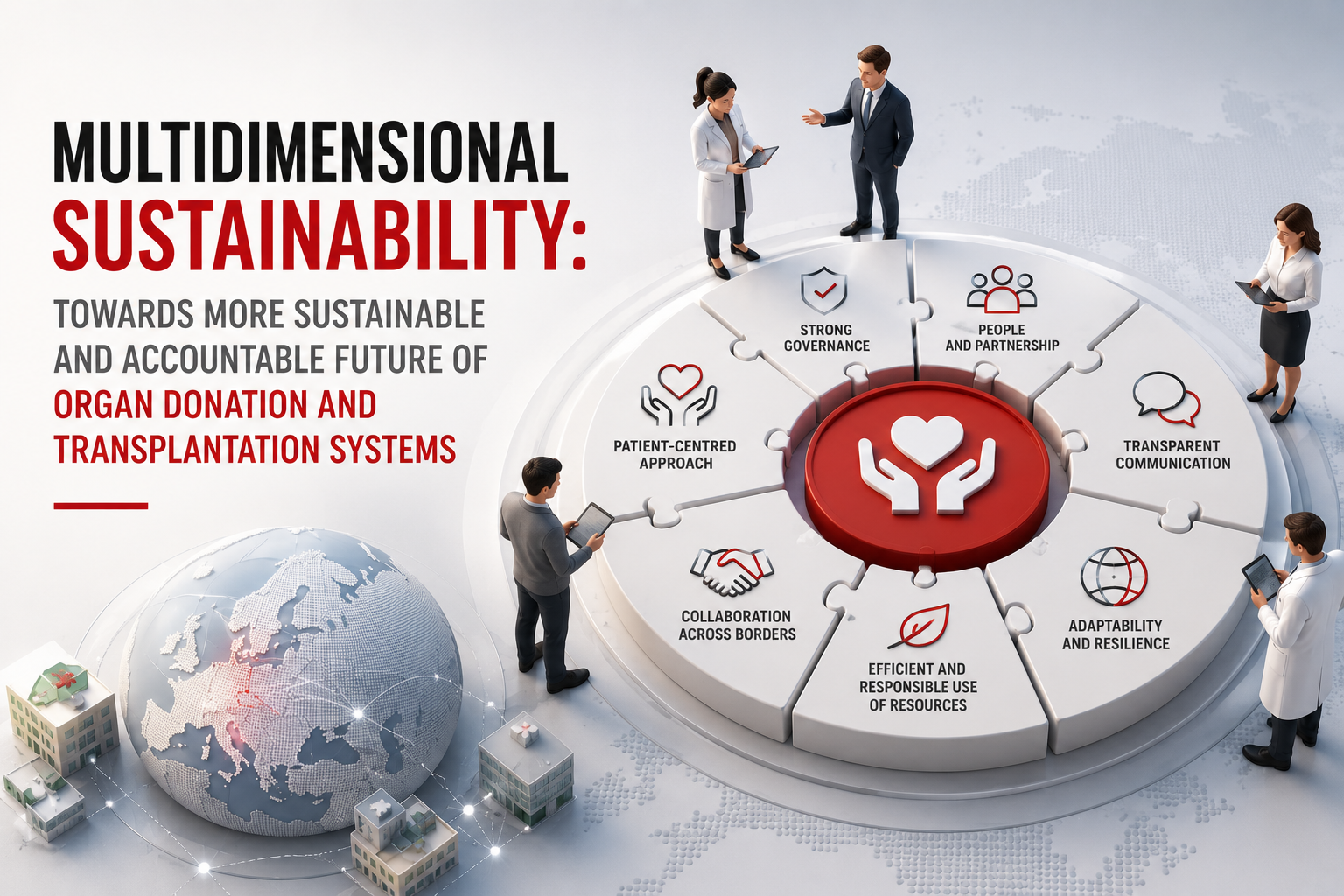
This is one of the main goals of the project BRAVEST work package dedicated to sustainability (WP 5). We will test whether clinical recommendations developed within the BRAVEST remain viable when they encounter real legal frameworks, organisational structures, resource constraints, cross-border dependencies and crisis-related failure modes. Project partner Slovenija-transplant Institute is leading this project task. Sustainability in WP5 is interpreted multidimensionally.
Implementation sustainability: whether recommendations are understandable, adaptable and usable in national and local systems.
Legal and ethical sustainability: whether implementation is compatible with national rules on death determination, consent or non-opposition, end-of-life care, allocation, data governance and cross-border exchange.
Financial sustainability: whether the cost of additional staffing, technologies, transport, diagnostics, machine perfusion, digital systems or emergency logistics is proportionate and affordable.
Organisational sustainability: whether systems have the necessary ICU capacity, coordinator time, laboratories, procurement teams, operating rooms, communication structures and governance arrangements.
Operational resilience: whether the full pathway can continue under stress and whether critical functions have protected staffing, escalation routes, alternative processes and fallback infrastructure.
Transferability and scalability: whether a recommendation can function across different European system models rather than only in one optimal setting.
Post-project sustainability: whether the resulting practices, cooperation structures and implementation evidence can remain useful after EU funding ends.
The aim is that the recommendations will be sustainable at the European level. That is why testing across diverse systems will be made.
System-level simulation methodology
The key methodological decision of Slovenija-transplant was not to limit simulation to the transplant operating room. Organ donation and transplantation are interdependent systems. Crisis-related failures frequently occur upstream or downstream from surgery and may stop transplantation even when the surgical team remains available. The WP5 simulation architecture therefore includes:
donor identification and referral in donor hospitals and ICUs;
donor assessment, management, screening and end-of-life interfaces;
donor-transplant coordination and protected professional roles;
laboratory, HLA and compatibility-testing processes;
organ procurement and retrieval-team availability;
allocation, national and supranational coordination, and cross-border exchange;
transport of retrieval teams and organs, including alternative logistics;
digital infrastructure, registries, communication platforms and cybersecurity;
continuity of transplant programmes and recipient prioritisation; and
follow-up care, telemedicine and broader system recovery.
This design strengthens the validity of WP5 because it captures system interdependencies. Examples of relevant failure modes include loss of donor referral during ICU overload, inability of laboratories to report, failure of allocation or communication systems during a cyber incident, loss of transport capacity after a natural disaster, or interruption of cross-border exchange in a small dependent system.
Archetype-based selection strategy
Clinical recommendation will be simulated in a network of centres with different activity volumes. Slovenija-transplant operationalised this requirement through an archetype-based strategy. The purpose is not to select only the “best” centres, but to represent different types of European donation and transplantation systems and therefore different vulnerability profiles.
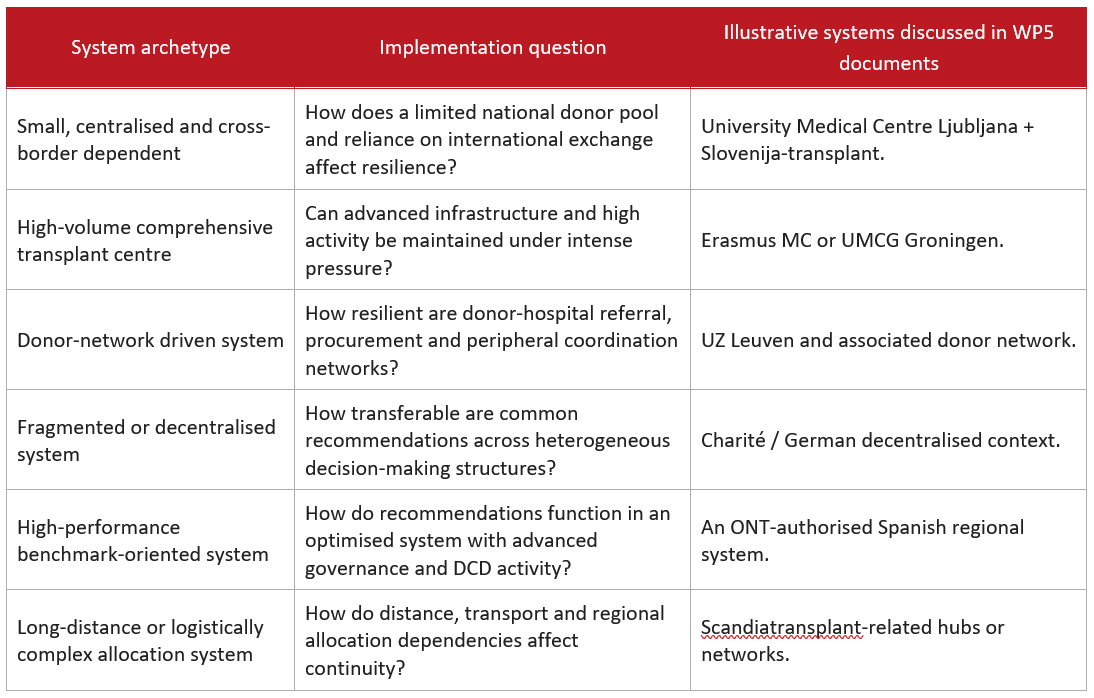
The selection documents also include cross-cutting functional layers—coordination and allocation bodies, laboratories, registries and data infrastructure—because these nodes may be more relevant to a given scenario than the transplant centre alone. The final invitation pool was expanded to 12 hospitals and systems to improve the likelihood of participation and preserve archetype coverage.
Crisis scenarios and evaluation
The planned assessment is not intended to produce a binary pass-or-fail result. It will examine the applicability of each WP4 recommendation, operational feasibility, assumptions, local legal and organisational compatibility, bottlenecks and failure points, minimum requirements, staffing and escalation thresholds, and adaptations needed for implementation.
At this stage, invitations for evaluation were sent to 12 centres. Hopefully, we will receive constructive and realistic evaluations of the recommendations.